Saturday, March 14, 2015

Moses Kotane gave his life to the struggle, says Pres Jacob Zuma in Pella village

Big image
Moses Kotane walks next to former president Nelson Mandela. (File: Jürgen Schadeberg)

Struggle stalwart Moses Kotane gave his life to the struggle for freedom, President Jacob Zuma said at the struggle stalwart's reburial service on Saturday.

"Moses Kotane gave his whole life to the struggle for freedom, justice and equality," Zuma said in a speech prepared for delivery at the ceremony in Pella, North West.

"We are filled with sadness but also pride and joy, for we have the privilege of celebrating the life of this highly regarded giant of our struggle for freedom."

Kotane was a former SA Communist Party general secretary and former treasurer general of the ANC.

Kotane, one of the first activists to be banned under the Suppression of Communism Act, suffered a stroke in 1968 and went for treatment in the then-Soviet Union, where he died in 1978.

He was buried in the Novodevichy Cemetery in Moscow, Russia.

On Saturday, Zuma said Kotane had finally come to his permanent resting place and said it was an honour to have to opportunity to bid him a formal farewell.

"We are privileged indeed to call this internationalist our compatriot, a man who was respected from Africa to Asia and Europe, because of his ideological clarity and commitment to the cause of freedom of the oppressed," Zuma said.

He said it was important to reflect on the "material conditions and social context" that shaped Kotane's thinking.

"These are the conditions that were to ultimately create a giant of our revolution whose life is worth celebrating without any reservation."

Kotane grew up under harsh conditions of poverty, engineered by the colonial regime to ensure that black people amounted to nothing more than a source of cheap labour, Zuma said.

He said during his childhood, South Africa was colonised and Kotane received very little formal education and had to go find work at the age of seventeen.

Zuma said it was important to note that Kotane was a hard worker, which earned him leadership positions.

"Through him, we want to inspire our youth in particular to read, work hard and rise through the leadership of organisations through commitment, dedication and hard work."

Kotane worked tirelessly to make South Africa a better place for all. South Africa's story would never be complete without mentioning Kotane who guided the country's revolution, said Zuma.

‘Towering figure’

"Compatriots we are laying to rest a towering figure in the liberation struggle," he said.

He told the Kotane family they finally had a place to go to mourn and South Africans had a monument to go where they could pay their respect.

"The people of South Africa and the world will now also have a monument to come and pay their respects, and draw inspiration from the life of Moses Kotane the fighter, teacher, commissar, administrator, intellectual, outstanding patriot, revolutionary and giant of our struggle.

"May his soul finally rest in eternal peace," said Zuma.

Cope welcomed the reburial of Kotane and said they knew how his family longed from him to lie in South African soil.

Cope said he was where he belonged and saluted Kotane for his selflessness.

"He had a clear vision for our country. He led the struggle, with others of similar commitment, so that all the people of our country could live in peace and harmony," Cope said in a statement.

"Moses Kotane struggled for all of us to be equal before the law and for the overcoming of poverty so that no-one in our country had to ever go to bed on an empty stomach."

The party said it would follow in his footsteps, sparing no effort in the struggle against poverty and inequality.

Police officers, along with sniffer dogs, were on site inspecting all cars entering the village. Pella Matlhako village, the ancestral village of struggle stalwart Moses Kotane, lay silent ahead of the reburial of his remains on Saturday.


: A portrait of Moses Kotane during a ceremony for the repatriation of the remains of Moses Kotane and John Beaver (JB) Marks on March 1, 2015 at Waterkloof Airforce Base in Pretoria, South Africa. Pic: Gallo Images / Foto24 / Lisa Hnatowicz

Senior government officials as well as residents from the village outside Rustenburg, in the North West, gathered at the Pella Sports Grounds where the service is expected to take place later this morning. President Jacob Zuma is also expected to speak.

Several residents who spoke to The Citizen sang praises for Kotane. Kebareng Bogopane, 72, said it was a blessing in disguise that the remains of one of the great stalwarts had been brought home.

“I am very happy that this had happened, today is one of the biggest days in North West” Bogopane said.

Mmamothusi Molokwane ,29,also expressed jubilation, saying Kotane will now rest in peace.

The remains of Kotane and another struggle stalwart JB Marks were repatriated to South Africa from Russia two weeks ago. Kotane, the former SA Communist Party (SACP) general secretary and ANC treasurer general died of stroke in 1978. Marks, also the former SACP general secretary and ANC’s treasurer general, died in 1972 of a heart attack.
Both were buried in the Novodevichy Cemetery in Moscow, Russia. Marks will be reburied in the Tshing township in Ventersdorp, North West next weekend.

President Jacob Zuma granted them both special official funerals.

President Jacob Zuma lashed out at his critics today, labelling them armchair revolutionaries who criticise left, right and centre.

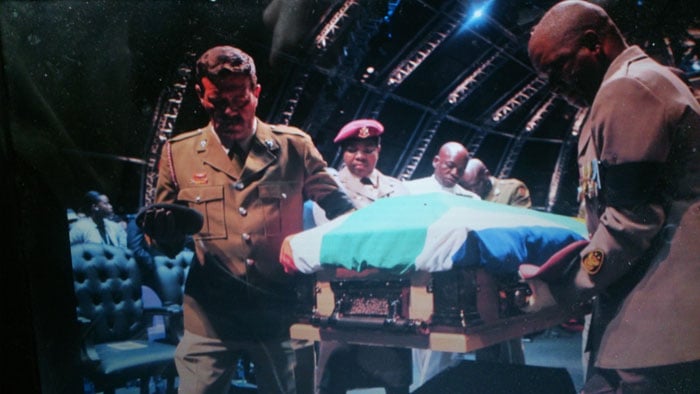
Pall-bearers carry the coffin of Moses Kotane, 14 March 2015, in Pella in the North West Province. Picture :Alaister Russell

Pall-bearers carry the coffin of Moses Kotane, 14 March 2015, in Pella in the North West Province. Picture :Alaister Russell

“There are armchair revolutionaries who only know how to speak day and night and produce nothing,”Zuma told mourners at the at special official service of the remains of struggle stalwart Moses Kotane in Pella Matlhako village outside Rustenburg, North West.

“There are so many of them these armchair revolutionaries. “Everyday they spend their energy and everything criticising. Moses Kotane was not an armchair revolutionary. He approached things based on the Marxism and Leninism theory.”

Zuma said leaders like Kotane were not confrontational. “They were very strategic,” Zuma said. “They did not go for the man they went for the ball.”

He said the country was bidding a final farewell to one of the finest organic intellectuals ever produced. “This was also a man who never saw the theory of Marxism as a dogma and he certainly did not approach it religiously,” Zuma said.

“On the contrary, he saw it as the most effective tool with which to analyse society and as a guide to action.” The president told the mourners that Kotane wanted to change South Africa.

“One of his remarkable contributions to the theory of our liberation struggle and the history of our country was his passion for the Africanisation of Marxism-Leninism,” Zuma said.

“Another unique characteristic of Moses Kotane was that he was part of that rare breed of leaders who understood the dialectical intersection of the class and national struggles.”

Zuma said South Africa was a much better place to live in than it was when Kotane left to go and pursue the struggle beyond the borders of the country.

Kotane’s family friend Wesi Seokoe said Kotane was not easily approachable but he was kind and disciplined. The reburial service was attended by deputy president Cyril Ramaphosa, former deputy president Kgalema

Motlanthe and former National Assembly Speaker Max Sisulu, among others. The remains of Kotane and another struggle stalwart JB Marks were repatriated to South Africa from Russia two weeks ago.

Kotane was one of the first to be banned under the Suppression of Communism Act of 1950. But he ignored his banning order to speak in support of the defiance campaign in June 1952.

Kotane, the former SA Communist Party (SACP) general secretary and ANC treasurer general died of stroke in 1978. Marks, who is also the former SACP general secretary and ANC’s treasurer general, died in 1972 of a heart attack.

Both were buried in the Novodevichy Cemetery in Moscow. Marks will be reburied Tshing township in Ventersdorp in North West next weekend.

Zuma has granted them both special official funerals.


Friday, March 13, 2015

Suspects arrested for SABC reporter mugging


Big image

A screen grab from the video showing SABC journalists being mugged outside Milpark Hospital in Johannesburg. (SABC, YouTube)A number of suspects have been arrested in connection with the mugging of SABC journalists outside Milpark Hospital in Johannesburg, according to reports.

eNCA reported that the arrests were made on Friday, following the announcement of a R100 000 reward for information on the incident.

National police commissioner Riah Phiyega said confirmed that arrested during a press conference and said a number of foreign nationals were arrested, and that they are expected to appear in court.

SABC contributing editor Vuyo Mvoko, foreign editor Sophie Mokoena, and journalist Chriselda Lewis were preparing for a live crossing on Tuesday night after covering the arrival of Zambian President Edgar Lungu at the hospital.

Video footage showing two men accosting Mvoko as he waits to deliver his report in front of the camera went viral.

Mvoko said later in an SABC interview that one of the men threatened him with a gun when he did not immediately give up his cellphone.

Earlier Gauteng police commissioner Lieutenant General Lesetja Mothiba said police would do everything in their power to ensure the suspects were caught.

"We are shocked at the brazen nature of this crime. The cameraman managed to film the incident and the faces of the suspects could be clearly seen," he said.

SABC News tweeted that suspects have been arrested.

Friday, March 6, 2015

“I will fuckin’ kill you, you black bitch” RACIALLY ABUSED: Sinethemba Memela says she was racially abused by two classmates and physically assaulted by one of them outside a Wits Law lecture venue this Monday.

IMG_2945

RACIALLY ABUSED: Sinethemba Memela says she was racially abused by two classmates and physically assaulted by one of them outside a Wits Law lecture venue this Monday. Photo: Palesa Tshandu.

by Anelisa Tuswa

A fourth-year Wits student was allegedly racially abused by one of her classmates outside a lecture room on Monday morning.

“I will fuckin’ kill you, you black bitch,” was one of the threats made by a white student, according to Sinethemba Memela, a law student attending an Intellectual Property lecture.

According to Memela, the incident started after she “confronted” two female students during the lecture as they mocked the accent of senior lecturer, Dr Malebakeng Forere.

Memela said the students were commenting on Forere’s pronunciation of the word “patent”.

“I turned around and asked them why does it matters how she says patent, we all know what she means,” said Memela.

“Unnecessary black bitch”

Memela said she tried to close the argument by saying the lecturer had a doctorate and did not need to be “undermined”, but added that she heard one of the girls refer to her as an “unnecessary bitch”.

When Memela asked them to repeat what they had said, one of the girls responded: “I said you’re an unnecessary black bitch”.

The verbal attacks later escalated into a physical confrontation as Memela was pulled by one of her aggressors outside the lecture venue. She says the student “pinched my breasts, daring me to beat her”.

The girl, according to Memela, was “screaming and shouting, beat me. Beat me, will fuckin’ kill you. You black bitch”.

Wits Campus Control has confirmed that Memela has filed a report. Michael Mahada, investigations manager, said Memela has made an allegation of an assault.

“After the matter is fully investigated it will be forwarded to the Legal Office to consider taking appropriate action against the student accused,” said Mahada. Memela filed both a report with Campus Control and said she went to the Career Counselling and Development Unit (CCDU) for counselling.

Tuesday, March 3, 2015

Medupi produces its first Power

 
Big image

The first power was produced out of Medupi’s unit 6 on Monday at 11:03, making it the first of the Medupi power station’s six units to be synchronised, according to Eskom.

Synchronisation, or first power, is the process whereby the generator in the unit is electrically connected to the national power grid, in such a way that its power is perfectly aligned with all the other generators to generate and deliver electricity into the national power grid.

According to Eskom CEO Tshediso Matona this is the final stage marking "an exciting milestone" towards full commercial power.

“Today, we celebrate the achievement with team Medupi. The electricity flowing into the grid marks a new beginning. Within the next three months, South Africa will see Medupi unit 6’s full potential of 794MW being fed into the South African national grid," said Matona.

"I congratulate team Medupi for their efforts in achieving this important milestone for South Africa.”

In anticipation of commercial operation, a power station manager has been appointed.

Eskom said over the past six years a core set of people were trained and developed to operate the cutting edge technology that makes Medupi "unique in the world".
 
“Approximately 350 men and women are waiting to join the force of South Africans making history when the unit gets operational. While unit 6 is the first of Medupi’s six units, it should be noted that all required auxiliary services for the entire power station are ready to ensure that Medupi’s total output of 4 764MW is fully synchronised to the South African power grid,” said  Matona.

For Minister of Public Enterprises Lynne Brown the synchronisation of unit 6 at Medupi is a step towards full power generation of 794MW and, therefore, a step closer to alleviating some of the energy challenges currently faced by South Africa.

"This will contribute significantly to South Africa’s and the region’s economy in the long run,” said Brown.

“We recognise that this is only the beginning, but I am confident that achieving this significant milestone will sustain the dedication and commitment of the Eskom team as they work towards the completion of the project."

Sunday, March 1, 2015

Moses Kotane would be reburied in Pella Matlhako, North West, on 14 March, while Marks would be reburied in Ventersdorp on 22 March.


Ntate Moses Kotane (Picture: AP)

Struggle icons Moses Kotane and JB Marks were on Sunday given a heroes' welcome by President Jacob Zuma during a ceremony for the repatriation of their remains from Russia.

"Their homecoming is a beginning of a new chapter," Zuma said in a speech at Waterkloof Airforce Base in Pretoria.

"It enables us to celebrate their contribution, and to raise awareness amongst our people, especially the youth, of what these two great men did for this country."

Exile

Political activist and trade unionist John Beaver (JB) Marks served as president of the Transvaal Branch of the African National Congress and was elected chairman of the SA Communist Party in 1962.

In 1963 he was sent to the ANC external mission in Tanzania.

He became ill in 1971 and went to the then-Soviet Union. He died of a heart attack in Moscow the following year.

Kotane was the secretary general of the SACP from 1939 until his death in 1978. He was selected to study at the Lenin School in Moscow.

Kotane, one of the first activists to be banned under the Suppression of Communism Act, suffered a stroke in 1968 and went for treatment in the then-Soviet Union, where he died in 1978.

Both were buried in the Novodevichy Cemetery in Moscow.

Home to a free South Africa

Zuma said the men's remains were returning to a South Africa that was very different from how it was when they left it.

"Today we have brought them back home, to a free South Africa.

"South Africa is today a democratic country based on the rule of law and fundamental human rights, largely owing to the sacrifices made by Moses Kotane, JB Marks and all other leaders as well as activists of their generation."

Zuma thanked Russian President Vladimir Putin and the Russian government for caring for the South African struggle stalwarts both in life and in death.

"Their tombstones at the cemetery which became their temporary home in Moscow indicated the respect and the status that they were accorded in that country, and further the cemented the strong historic ties between South Africa and Russia.

"The co-operation of the Russian Federation in our efforts to bring these two giants of our struggle back to their land of birth, and the remarkable and stately send-off yesterday when they left Russia will also forever be remembered by the South African people as a gesture of true friendship."

Kotane would be reburied in Pella, North West, on 14 March, while Marks would be reburied in Ventersdorp on 22 March.

Reaction

The Congress of the People expressed satisfaction with the repatriation of the remains of Kotane and Marks to South Africa.

"These were two outstanding leaders of the struggle, who went abroad to fight for the freedom of our people, needed to come home and lie in South African soil," Cope spokesperson Dennis Bloem said in a statement.

The party believed, however, that the men would have been disappointed at persisting poverty, corruption and service delivery problems in South Africa today.

"They would also have been shocked at how huge and rampant corruption has become in our country; or how some of their former comrades are in the forefront of corrupt activities and self-enrichment," Bloem said.

"Cope is convinced, more than ever before, that the best way to honour the fallen heroes of the struggle, such as Moses Kotane and JB Marks for example, is to continue the fight to end the poverty and inequality that blight our society."